For parents of children aged 4 to 16
A clear digital pathway from first screen to 16.
What to say, what to set and what to do next at every age. Ten minutes a day together, so your child reaches sixteen ready for a phone and social media.
Three questions. Two minutes. Free. No card required.





Every answer you find says ban it all, or give in and dread it. Neither one teaches your child a single thing. There is a third way, a guided one.
Ask anything, any hour
The expert in your pocket at 11 o’clock.
It’s 11 o’clock and you’ve just seen something on their phone. You cannot ring anyone. You cannot think straight. You just need to know what to do before they wake up. DiGi has read every study so you do not have to. Tell it what happened and it gives you a researched answer and the exact words to use tomorrow morning.
Not general advice. The script for tonight.
And DiGi remembers. What you tell us matters: your child’s age, their stage, what happened last month. Every answer starts from your family’s history, not from zero.
- ✓Knows your child's exact age and developmental stage
- ✓Remembers what you have told it, week to week
- ✓Covers screen time, gaming, social media, mood, sleep and online safety
- ✓Built on Odgers, Orben, Przybylski, Livingstone and the NHS guidance

Tap a card, get the script
The moments you will recognise
Bedtime every night
"He will not hand over his phone at bedtime. Every single night the same argument. I dread it."
↺Tap for the fix
What actually fixes this
You are not overreacting. Screens in the evening, and especially in bed, push sleep later, and teenagers need their sleep more than most. The argument is not about the phone. It is about the bedroom. Say: "The phone charges in the hallway overnight. Not as punishment. This is the rule for the whole house including me." Make it structural tonight. There is no argument when there is no decision to make.
Stage 2 to 4 · Ages 8 to 15
Mood crash
"Her mood after she comes off her phone is awful. Flat, snappy, impossible to reach. I do not know if the phone is causing this or if it is just her."
↺Tap for the fix
What actually fixes this
A flat mood after screens can have a few causes: a rewarding thing stopping, tiredness, hunger, what they were watching, who they were talking to. It is a pattern worth tracking, especially at 11 to 13, not a verdict. Say: "I notice you seem low after your phone time. I am not upset, I want to understand it with you." Track it for two weeks. The pattern becomes the conversation.
Stage 3 · Critical window · Ages 11 to 12
I keep shouting
"I lose patience every time. I end up shouting. I feel guilty. And tomorrow the exact same thing happens again."
↺Tap for the fix
What actually fixes this
You are not a bad parent. You are a parent without a script for a problem that did not exist when you were a child. Guilt after shouting means you care. Say nothing tonight except: "I am sorry I shouted earlier. Tomorrow we try again." Then use DiGi to get the exact words before the next moment happens. You do not lose patience when you already know what to say.
All stages
Why not just ask a chatbot?
Four things a free chatbot cannot do for your family
A chatbot waits for your next question. This is built around one family, and it checks back in with you.
It remembers last Tuesday.
Tonight’s answer starts from what you told DiGi last week, the worry you are tracking and the words that worked. You never explain your child twice.
Your child has their own app.
Their jobs, stars and lessons, opened from one link with no login. They take part instead of being talked about.
You see the worry move.
Tap a face for it from the first day and you can see where bedtime started and where it is now.
The words are ready, and you can print them.
Scripts written in advance from the research, not made up on the spot. Say whether one worked and DiGi remembers that too.
What to do, when, how
You are not the strategist.
You are the parent. We drive.
Most parents argue with their kids over screens, and policing without a plan is exactly what every parent has been left to do. So we do the planning. Every week the pathway hands you the next step: this week’s lesson, tonight’s script, the one habit to set. Start at 4 or start at 13, it meets your child where they are.
Ten minutes a day
One moment, one script, one small win each evening. Miss a few days and the pathway catches you up. Life happens, the plan holds.
The road to 16
Your child moves along five stages, earning passport stamps as they learn. By the time the apps arrive at sixteen, they are ready, because ready was built.
They earn their screen time
Real jobs and play earn stars. Stars buy agreed screen time on the star timer. The argument ends because the deal is theirs, and they keep it.
Guardrails you teach. Not gates you lock.
The real thing, not a mockup
One calm system.
Every part earns its place.
A script and a tip for the exact fight you are having. Ten minutes a day, and the pathway catches you up whenever life happens.
Your child ticks real jobs in their own app, stars land in their star bank, stars buy agreed device time. The fight ends because the deal is theirs.
Safe device settings by age, matched with the reward star system. Outside play pays the most stars, and the wellbeing tracker shows the balance shifting.
Age by age lessons so they can spot an algorithm, a fake and an AI chatbot long before 16. Social media and AI literate, not just supervised.
Term dates, homework rhythms and school activity messages home, so the plan fits real weeks, not perfect ones.
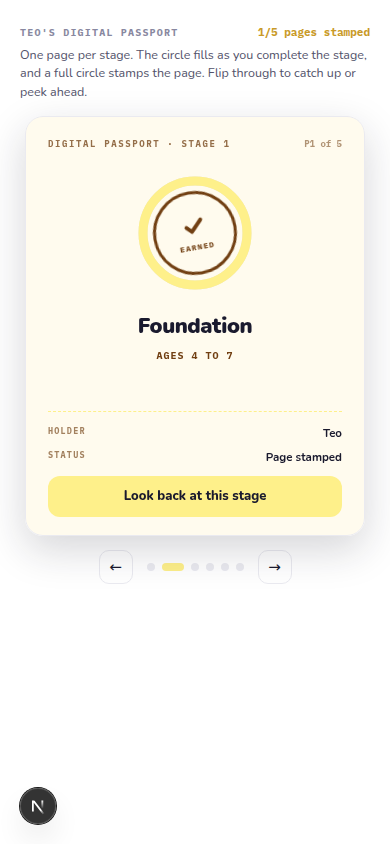
Every stage stamped, every page earned. Tap each page open above, done by 16.
Plus printables in English and Spanish, 24 age gated learning games, and school activity messages home. No device of their own yet? Everything works through your app, so a six year old can hold their first jobs list years before their first phone.
For schools: see the school programme
See inside
This is the real thing, not a mockup
Every picture below is the product as families use it today: the passport your child fills up, the bucket lists you print, the sheets that earn stars.
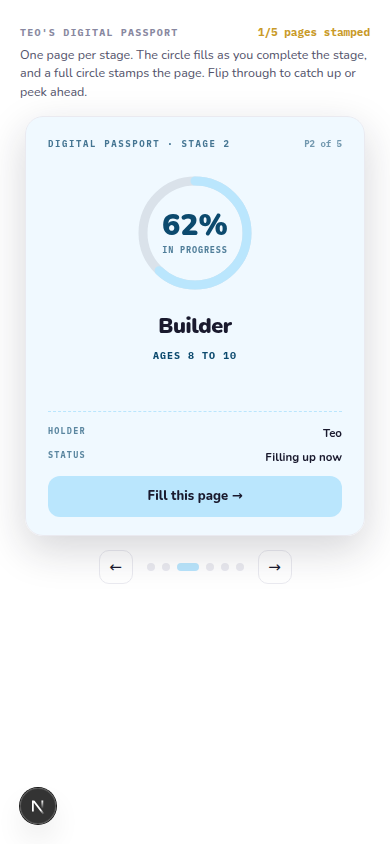
One page per stage, the circle fills as they learn, a stamp when the stage is done. The whole journey to 16 in a little book they want to finish.
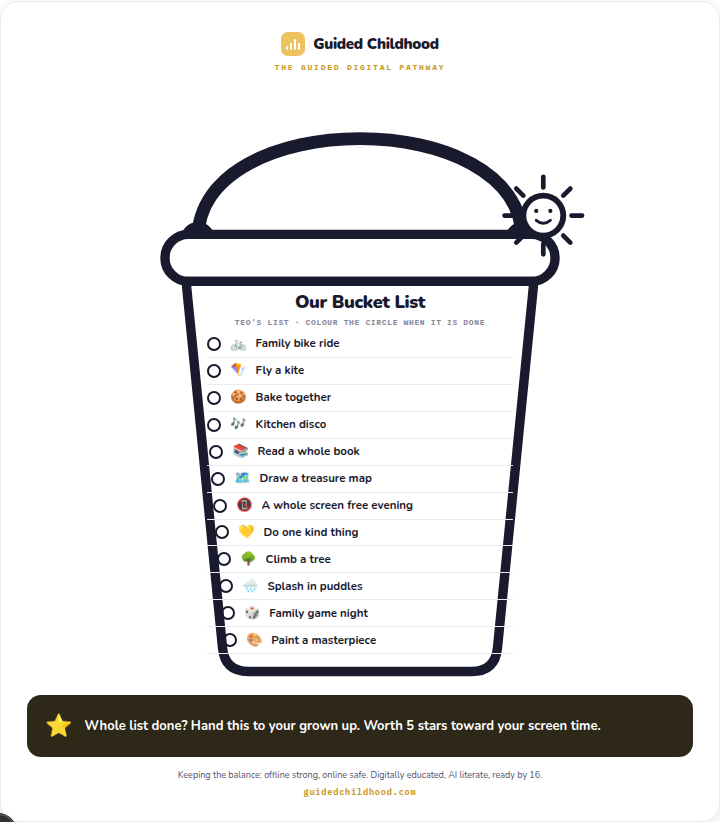
Pick the ideas together, print the bucket, colour it in. The finished page is worth stars toward their screen time.
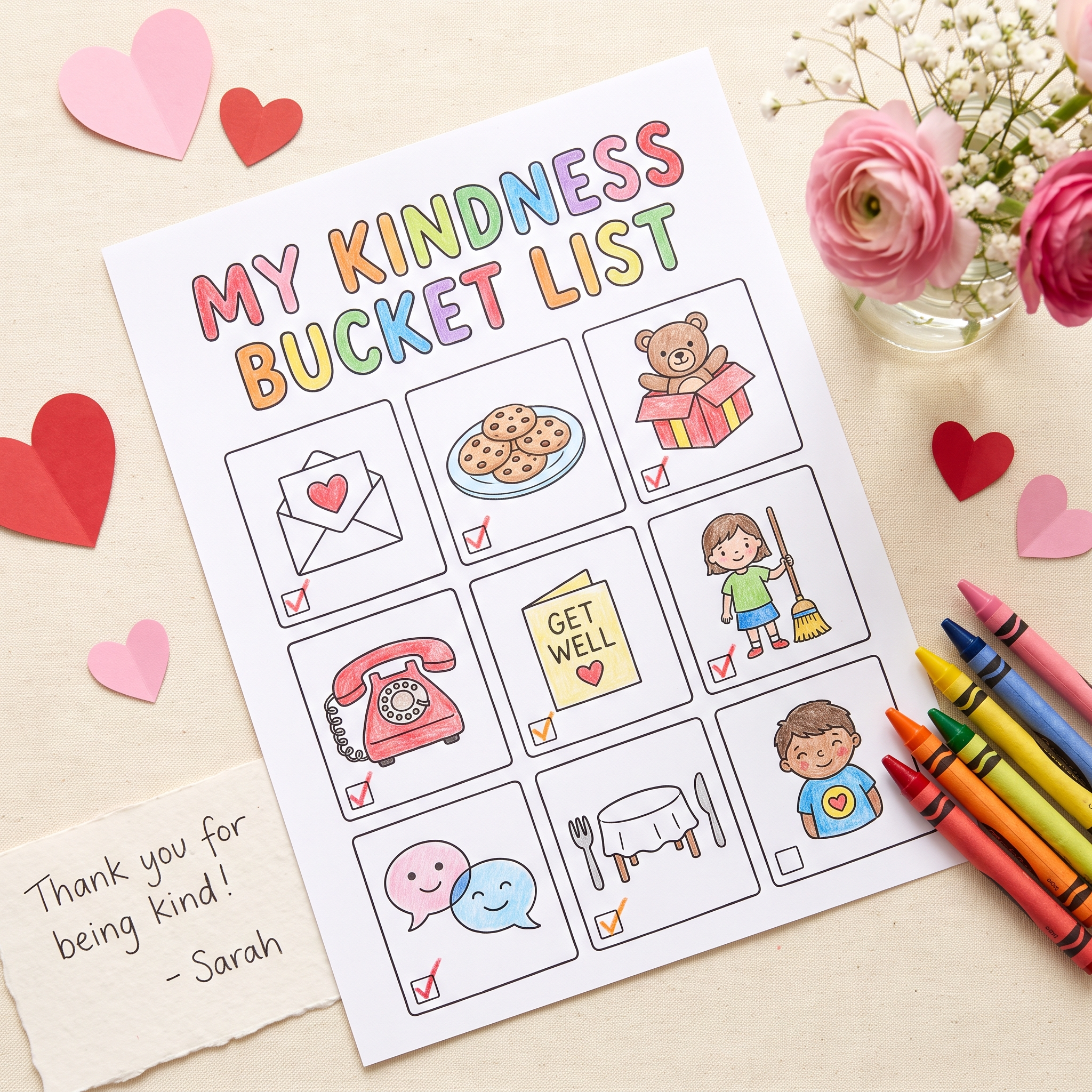
A library of beautiful printables, in English and Spanish, every finished sheet handed back for stars.
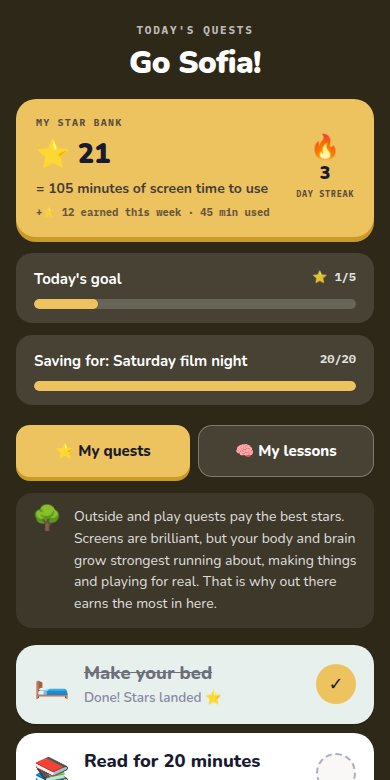
Quests to tick, jobs to request, and a star bank that turns into agreed screen time, with outside play earning the most. No device of their own yet? It runs from your phone.
Progress a child can hold: lessons done, quests ticked, pages stamped. Screens earned, never fought over.
Safety without surveillance
We will never ask you to spy on your child.
Control apps sell certainty and deliver an arms race. Children learn the workarounds, and every fight gets worse. We teach the settings worth setting, show you what to look for, and build the one thing no app can: a child who comes to you first.
The settings that matter
Per age, per device, done together rather than in secret. A checklist you set once and review each stage, so the workaround conversation is a trust conversation, not a discovery.
The signals worth noticing
Mood after screens, sleep, withdrawal from things they loved. What the research says to pay attention to, for your child and for you, without panic and without diagnosis.
Balance that holds
Screens and outdoors, both done well. Quests push play outside, the star timer keeps the deal honest, and the wellbeing tracker shows the balance actually shifting.
What changes and when
Tonight. This term. Sixteen. Always.
"The phone charges in the hallway from tonight. Whole house rule, mine included." One script, one calmer bedtime.
The fights shrink. The conversations open. You trust yourself as a parent again.
They walk into social media the way you wanted them to. Ready, not just released. Passport stamped, habits set, and they still come to you.
"I trust myself as a parent again." The rules become a relationship. That is the whole point.
The idea behind the pathway
Your child's social media passport
Just as a child cannot drive without a licence, they step onto social media with a passport they have earned, one stage at a time. This is not about banning. It is about preparation, the skills to navigate the digital world rather than hide from it. Your child earns the passport page by page: safe digital usage, healthy habits from the start, no matter what age they join.

No feeds, no solo device, nothing to navigate alone yet. This is where a child first learns that some things on a screen are true and some are not, side by side with you. Every stage after this builds on it.
This stage in one habitKeep it shared. Same room, same screen. The passport is being written already, in how calm and normal screens feel at home.
At 16, when social media and the first vote arrive together, the cliff edge is just a step. Your child is prepared, educated and safe, and so are you.
The parental device settings relax as each stamp is earned, so freedom is age related and earned, never handed over all at once. A feature phone around 9, a guided smartphone later, real social media at 16.
Joining when your child is 13 or 15? You never miss a stamp. We start where they are and build a catch up plan to get them up to speed, so the passport still completes by 16.
Start where your child is
Where is your child right now?
Five stages, one goal: a child with a healthy relationship with screens, who comes to you when something goes wrong.
Multiple children at different stages? One account covers all of them.

Justin Phillips
Founder, Guided Childhood
I watched my daughter scroll for three hours and realised the conversation I was missing
I am Justin Phillips, founder of The Social Billboard and Guided Childhood. I am not a researcher. I read the researchers. Then I built a platform that translates what they found into something parents can actually use this week.
The problem is not the phone. The problem is nobody gave parents a map. A law about social media does not give you one. Guided Childhood does.
Find my starting pointThe science moves. So do we.
The leading researchers in children, social media and mental health, and live data from national bodies, NHS and NSPCC among them. DiGi is tested every Monday against a fixed set of hard cases and the research library is refreshed twice a month with a human deciding what goes in, so tonight's guidance matches the world your child is actually in. See the evidence
From our first families
Real words from real parents
You are not doing this wrong, and you are not doing it alone.
I was so nervous about giving my 11 year old a smartphone. With DiGi I can ask for help at every step, it shows me exactly how to set things up safely, and it settles me whenever a problem comes up.
It was gone midnight and I still could not get my 12 year old to sleep. I have so many moments like that in a week, and DiGi remembers them. It catches up with me on Sunday with a plan to make it better, and I do not feel like a bad parent anymore.
I was worried Lilly was on her device too much. Now I can track how she is doing, and the quests help her balance her screen time with getting outside to play.
Imagine this time next year. You know exactly what to say. The conversations do not spiral. Your child comes to you.
- ✓Four days inside the platform
- ✓DiGi, with a daily limit
- ✓A starter set of scripts
- ✓Your age stage roadmap
The founder rate is claimed at sign up, first 50 families only. Start your trial now and it is yours.
- ✓The star quest: jobs earn stars, stars become screen minutes
- ✓Your child’s own app, no login, plus the paper star chart
- ✓All 160 scripts and the daily moments
- ✓DiGi, unlimited
- ✓The homework decoder and curriculum help
- ✓Full lesson library, every stage
- ✓The wellbeing tracker, and what is working, per worry
- ✓The passport to sixteen, and printables with their name on
- ✓School lesson packs included
- ✓Everything in annual
- ✓Pay month to month
- ✓Cancel any time
FAQs
Questions parents ask us
At what age should my child get their first phone?
There is no single right age. Guided Childhood uses a five stage pathway from ages 4 to 16. The right time depends on your child's stage of development, your family structure, and what boundaries you have in place. Stage 2 (ages 8 to 10) is typically when children get a restricted first device. Stage 3 (ages 11 to 12) is when smartphones become more common. The question is not when but how.
How do I deal with screen time arguments every day?
Screen time arguments happen when limits are inconsistent or when structure is missing. Guided Childhood gives you the exact scripts for the most common daily battles including after school TV demands, bedtime phone fights, and gaming meltdowns. The fix is structural, not stricter. One consistent routine takes most of the daily negotiation out of it, and you rate the worry each day and watch your own number move.
When should children be allowed on social media?
The UK minimum age for most platforms is 13. Research by Dr Amy Orben at Cambridge identifies ages 11 to 13 as the highest sensitivity window, particularly for girls. Guided Childhood Stage 3 covers exactly this: the conversation to have before access, what to watch for during access, and the boundaries that protect without destroying trust.
Is screen time really harmful for children?
The research is more nuanced than most headlines suggest. Professor Candice Odgers at UC Irvine and Professor Andrew Przybylski at Oxford both find that the effects depend heavily on context, vulnerability, and structure. Screen time is not uniformly harmful. Too much, too early, without structure, for already vulnerable children is where risk concentrates. Guided Childhood is built on this nuanced research, not panic.
What is Guided Childhood and how does it work?
Guided Childhood is a clear digital pathway from first screen to 16 for UK families. You identify your child's stage, then the pathway tells you what to do, when to do it and how to do it: daily moments with the exact words, 160 scripts for the hard conversations, 100 lessons you can teach at home, a Digital Passport your child earns stage by stage, family quests where real jobs earn stars and stars buy agreed screen time, a child app for checking and requesting jobs, printables in English and Spanish, 24 age gated learning games, device setting checklists, a wellbeing tracker, a family agreement builder, and DiGi, your evidence led guide, whenever you need the specific words. It takes around ten minutes a day, and if you miss a few days the pathway catches you up.
Does Guided Childhood prepare my child for the UK under 16 social media ban?
Yes, that is the core of it. The UK plans to restrict under 16 access to some social media from spring 2027. A deadline delays the apps. It does not teach children anything. Guided Childhood builds the judgement in the years before: a five stage pathway from age 4, lessons in misinformation, algorithms and AI literacy, and a Digital Passport earned stage by stage, so 16 arrives as a step rather than a cliff edge. Arriving with habits beats arriving with rules.
How do children earn screen time on Guided Childhood?
Children tick off real jobs and chores in their own app, and outside play pays the most. Stars land in their star bank, and stars buy agreed screen time on the star timer. Because the deal is theirs, the daily argument ends. Families without a child device run the whole thing from the parent app.
How do I teach my child about AI and chatbots?
Guided Childhood includes age by age AI literacy lessons: what an AI chatbot is, why it sounds confident when it is wrong, how algorithms and recommendation feeds work, and how to spot AI generated content. By 16 your child is AI literate, not just supervised.
Is banning devices better than teaching digital literacy?
OECD research finds device access among UK teenagers is now nearly universal, so the gap that remains is not who owns a device but who is taught to use one well. A ban does not close that gap. It removes the deep end from the child who was never taught, while the child already getting lessons is unaffected. Guided Childhood teaches digital literacy in stages instead, the same way children are taught to swim.
It is not too late.
It is not too early either.
There are more school pickups, more car journeys, more evenings ahead of you than behind you. Start tonight. One account covers all your children.